Leadership
General Leadership
Leadership Principles
No matter what the role, from Platoon Commander to Section 2IC, there are some common leadership principles which should always be adhered to. We’ll now explore some of these principles in more depth:
-
Task by name - Those familiar with the Bystander Effect understand the issue that occurs when a general command is given to a group of people. Say, for example, as a Section Commander you give the following command “Someone throw a grenade into that room” - It’s likely that one of two things is now going to happen. Either, nobody is going to throw a grenade, with each person expecting that someone else is going to do it, alternatively, everyone in that section is going to throw a grenade into that room, resulting in a massive whirlwind of explosions and shrapnel. Neither are the ideal scenario. The correct way to do this, is to assign a specific task to a specific individual, consider the following: “Bob, get a grenade into that room”. It’s clear what you want to happen, and who you want to do it.
-
Lead by example - It’s hard to stress this point enough. Act how you want those following you to act. The effects of a leader not leading by example can be devastating. If people see their section or fireteam leaders messing around, not doing what their supposed to, or just otherwise being a disruptive influence - there is a good chance that they’ll follow along.
-
Make decisions - An important part of being a leader is making decisions. These can be tactical, like those made by a section or fireteam leader, or they can be strategic, like those made by a platoon commander. Either way it’s important to decide quickly, and then set a plan in motion. Examples of this occurring at the section level can be seen in the normal reaction to contact drills. Once the bullets start flying a decision has to be made, what’s our current situation? Is this a contact we can deal with? What is the best way to deal with this contact? A section commander might determine that they have been drawn into a firefight against a much larger opposition force, and that they best option might be to break contact. If that is the decision, then they should work to quikcly implement a plan of action.
-
Avoid a knee-jerk reaction - This might seem like a counter argument to the last point, but it’s just as important. While doing something is usually better than doing nothing, you should wait until you feel you have sufficient information available to make an informed decision. Mid-firefight you’re unlikely to be able to gather every single bit of possible information with 100% accurracy, so you’ll need to decide a suitable cut-off point for decision making - this could be when you start taking casualties. Consider the following example, your section is engaged by a few rifleman at medium range, the initial reaction might be to close to contact, however by standing your ground you notice more hostile forces maneuvering into position, and realise that this engagement is part of a much larger ambush which has just been set in motion. Your reaction is now likely to be a lot different, up against a much larger hostile force you might instead to break contact and make a tactical withdrawal from the area. Committing to closing on that contact too soon could have gotten your entire section killed.
-
Give clear orders - You’ll all of heard bad orders given at some point. “Take the thing and go put it by the other thing”. Being forgetful is an unfortunate part of being a human being, and we’re not proposing that those who forget things should be court martialled and then executed - however - we can likely all agree that an order like the above is needlessly ambiguous. While it’s entirely possible that someone might be able to accurately guess what you mean by context, we should make an effort to only give an order if we’re sure what it is that we’re asking for.
-
Don’t micro manage - Micro management as a leader usually results in 1) Making your role more stressful than it needs to be and 2) irritating the people that you are micro managing. A large part of leading is trusting those below you you to do their jobs. A section commander should trust the members of their fireteam to perform their role, and trust the Section 2IC to lead their fireteam. A platoon commander should trusted the FAC to control the air assets, and trust the platoon sergeant to perform any tasks assigned to them.
-
Remember the environment - Remember that while we enjoy an organised and structured environment, it’s still a game, and the people attending the events aren’t conscripts that have no choice but to be there, but instead are volunteers that have chosen to spend their free time participating in community events. Not many people enjoy giving up their Saturday evenings to be shouted at by someone doing a poor impression of a drill sergeant they once saw in a movie. Unlike any real world military organisation, we don’t have the benefit of a captive audience, there is plenty of other communities that do things similar to us - and they can just as easily take their custom elsewhere if the experience we provide is negative. If you’re looking for some additional reading on this topic, we’d recommend checking out the section on ‘Practical Leadership in Gaming’ in Dsylexci’s TTP3.
Operational Timeline
Overview
As a leader, the weekly event will last slightly longer, as there is some pre-event and post-event planning and admin that must take place. We’ll first take a look at the the operational timeline as a whole, and then we’ll breakdown what the important sections involve in more detail.
Timeline
- 1700: Orbat published
- 1730: Zeus Login & Map Preparation
- 1800: Platoon Commanders Briefed
- 1815: Teams Leaders Briefing
- 1830: Pre-kickoff admin
- 1900: Full-scale briefing
- 1905: Section Briefing
- NCO Debrief
Breakdown
Orbat published
In the hours leading up to an event, semi-random selection will occur from the NCOs to decide who will be performing which leadership role in the operation, and this result will be published in the NCO channel.
Zeus Login & Map Preparation
At this point, the game masters for the event will load up the map and have a discussion about the objectives and general format. They’ll have the chance to perform any initial setup work and decide what information will be given to the platoon command element.
Platoon Commanders Briefed
This is the initial planning phase - The platoon command team will load in to be briefed by the game masters and draw up an initial battle plan.
Teams Leaders Briefing
By this point, all of the leaders for that event should be present in-game. They’ll then recieve a briefing from the platoon command team on the proposed battle plan for that session, this initiates the second phase of the preperation - the ‘request for comment’. Section leaders will have the chance to ask questions and make suggestions on changes to the proposed plan.
Pre-kickoff admin
In the last 30 minutes before the event starts, you’ll have the opportunity to resolve any miscellaneous issues. This could range from technical issues to issues with equipment and assets, as well as preparing the briefing that will be given to the rest of your section.
Full-scale briefing
The full-scale briefing involves the entire platoon gathering to the briefed by the platoon commander. This briefing will cover things like the general conditions of the theatre, rules of engagement, civilian activity, callsigns, signalling and logistics.
Section Briefing
In the final 5 minutes before kick off, the sections are briefed by their team leaders on mission-specific objectives, movements and taskings. As soon as this is complete, teams should prepare for departure.
NCO Debrief
After the session, and after the general group-wide debrief has taken place, the NCOs will meet in private to discuss any of the matters not suitable for the group-wide debrief. This will include but is not limited to:
- Discipline issues
- Issues with tactics and procedures
- Post-action review of problematic occurrences (Friendly fire, asset destruction, objective failures)
- Other leadership pain-points

Discipline
As stated above, we’re not looking for military-strict, but problem characters should be identified and dealt with efficiently as keeping them in the game can set off a chain reaction that descends into chaos and disorganisation. For this, we have the card system. You can recieve two types of card:
Yellow Card
The yellow card is a warning for minor infractions, things that cross into disruptive, but where removal from the game could be considered too heavy-handed an approach. Here is a non-exhaustive list of things that you could issue a yellow card for:
- Back-seat commanding - Subordinates attempting to excercise control over the team not compatible with their in-game role.
- Intentional ignorance of RoE, or other gameplay limitations - A key example of this is the shooting of civilians with no reasonable grounds to do so… ‘because they looked at me funny’.
- Radio Spam - Not excercising radio discipline or shouting down the radio unnecessarily.
- Back-chatting, being uncooperative, or other malice - It’s unlikely that everyone will agree with your tactics all of the time, and that’s okay - but that’s a discussion point for the debrief, not for the battlefield. If players are willfully ignoring commands, or refusing to action them because they disagree, that’s not acceptable.
When issuing a yellow card, make sure it’s clear that you are doing it, and what is is that you’d like the player to stop doing:
Bob, yellow card, stop shouting down the radio
Players can recieve a maximum of two yellow cards. Reciept of a third yellow card is automatically a red card, which we’ll talk about next.
Red Card
A red card signals the removal of a player from the session. This means they have either triggered three minor infractions (yellow cards) or one major infraction. Examples of major infractions include:
- Racism or abuse towards any member
- Talking in side chat
At this point, letting them continue to play is detrimental to the experience for other players.
Section Leadership
In this section we’ll focus in on the requirements and procedures for good section leadership. As mentioned on the Group Organisation page, an infantry section is a team consisting of 8 men split into two fireteams. The first fireteam (charlie) under the direct control of the Section Commander, with the second fireteam (delta) under the control of the section 2IC. We’ll be focussing on the three stages of an operation:
- Pre-Combat
- During Combat
- Post-Combat
Pre-Combat
This phase consists involves preparing your team for the upcoming session. This is everything from sorting out the organisation of your section, resolving equipment issues, and briefing.
Briefing
Assigning Fireteams
Your section should be split into two fireteams - this is implemented through the use of team colours with blue team being the charlie fireteam, and red team being the delta fireteam. You can then use these colours during the operation to assign tasks to each team.
Red team, flank left!
Radio Setup
Before continuing, you should ensure that all of your section members are on the correct radio net. This is implemented by performing a group radio check, simply issue the ‘sound off’ command and wait to hear each of your section members say their name over the radio. If you here everyone, then you know they are on the correct net.
Hierarchy
It’s important that all team members understand the hierarchy of the team, this means they’ll know who to turn to in the event that you are put out of action. If they’re not already aware, introduce the 2IC and make sure that everyone is aware who they are. You should then brief them on the general hierarchy of the section, this is up to you to determine, but as standard it should go like this:
- Section IC
- Section 2IC
- Medic
If you have some more experienced members in your team, you may wish to appoint them as a 3IC in the event that both the section leaders are put out of action - this is a completely optional step, but highly encouraged.
Operation-specific details
In the final phase of the briefing you’ll move on to the operation-specific details. This should cover things like:
- Insertion plans
- How are the team getting into the AO? Car? Helicopter? Parachute jump?
- Specific movement orders
- What objectives are being tackled, and in what order?
- What sections of a given area are the team responsible for?
- Reaction to contact
- Should troops dismount on contact?
- What should the team do if under artillery or mortar fire?
- Essential Equipment
- Does the team have mission-essential equipment (Example: explosives for a destroy objective)?
- Can the team deal with an armoured contact?
- Emergency Plans
- If the team sustains heavy casualties, what is the emergency plan?
During Combat
Reacting to contact
When your team comes under fire, you will need to be able to analyse the threat and respond accordingly. Broadly speaking you have a few tactical options:
- Stand and fight
- Break Contact
- Close to contact
You should consider some of the following variables when making your decision:
- How combat effective is your team? Are you at full fighting strength or are you depleted?
- Do you have enough ammunition for a sustained firefight?
- Where are friendlies relative to you? Could anyone move to support you if required?
- What force multipliers are at your disposal? Artillery? CAS?
Regardless of the tactical decision you’re about to make, there is one critical thing you should always, always do - let command know that you’re in contact.
Zero this is 1-1, contact, wait out
While you’re considering the tactical options on the ground, this sets some wheels in motion in the background. Command, now aware that you’re in contact, can work to free up additional teams and assets in case you require support. This can have a long lead time, with units often having to finish their current tasking in order be on standby to provide support - so don’t delay on sending this message.
Stand and fight
You may determine that given your current situation, you’re best off holding your position and engaging with the enemy. This is usually a good idea if you are near or in hard cover with contact at medium to long range.
Break Contact
If you determine that you’re up against a force that you will likely be unable to beat, either through the shear number of hostile forces, or due to the fact that they are bringing heavier assets to bear - you may decide to break contact. This involves making a ‘tactical withdrawal’ and moving away from the contact. You can implement this using either bounding or peeling. If you are currently undetected by the enemy forces, don’t engage them unless strictly necessary to make your escape and instead simply slip away back into cover or concealment.
Close to contact
If dealing with contacts engaging you at range, or utilising certain terrain features like buildings, undulating hills and valleys, you might make the decision that your best bet is to close contact with the enemy and engage them at a shorter range. This can be implemented with a bounding manoeuvre, and should only be attempted if you judge your team to be combat effective. One team will lay down supressive fire, the purpose of which is to keep the enemy forces behind cover, while another team advances to deal with the threat.
Post Combat
After the shooting has finished, the immediate priority is to assess the current combat effectiveness of your team. You’ll then need to feed this information back up the chain, so that the command team know that you are contining with your tasking, or if they need to free up additional resources in order to assist you.
AMCAS Report
A quick way to assess the effectiveness of a team is by requesting an AMCAS report. This is short for ‘Ammunition and Medical’. It works very similar to that of a sound off, each member of the team say their name (thereby confirming that they are up and awake), along with a colour based assessment of their ammunition and medical status. The colours work on a traffic light system:
- Green - 100% fit to continue with the current tasking
- Amber - Walking wounded or requiring resupply, but otherwise free to continue with tasking
- Red - Urgently requiring medical treatment or ammunition, could not commit to a sustained firefight.
An AMCAS report might look a little something like this:
Right team can I get an AMCAS report?
Team members would then reply:
Bob - Green on ammunition and medical
Frank - Green on ammunition, amber on medical
Jim - Red on ammunition, green on medical
Platoon Leadership
Battle Planning
Colour Coordination
We’ll assume for the purposes of this guide that you are managing a group of up to 30 players, operating across three rifle sections with a commanding element and some supporting air assets.
 |
||
|---|---|---|
| Platoon Command | ||
 |
|
|
| Reaper-1-1 | Reaper-1-2 | Reaper-1-3 |
 |
 |
|
| Ugly-5-1 | Viper-4-1 | Viper-4-2 |
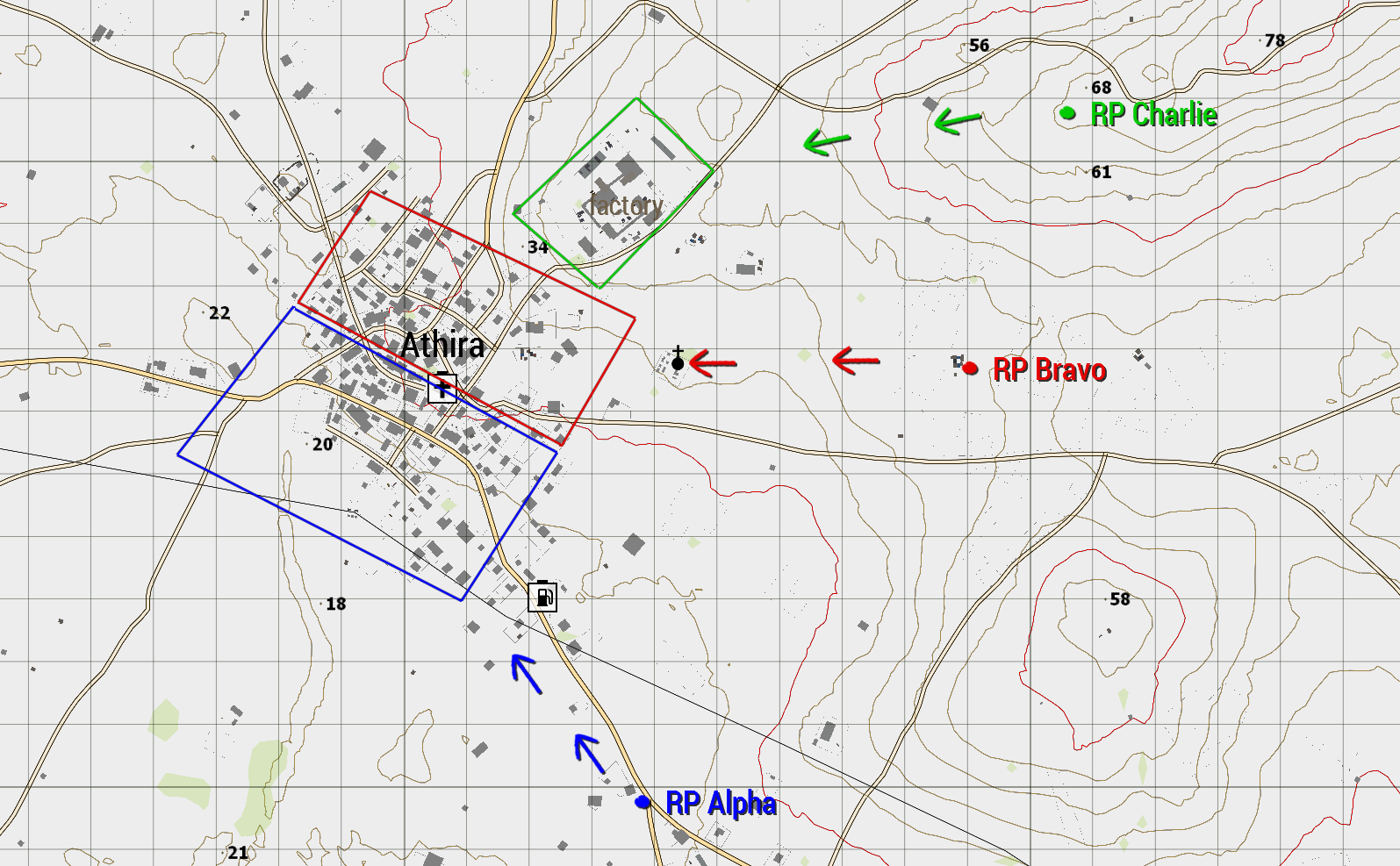
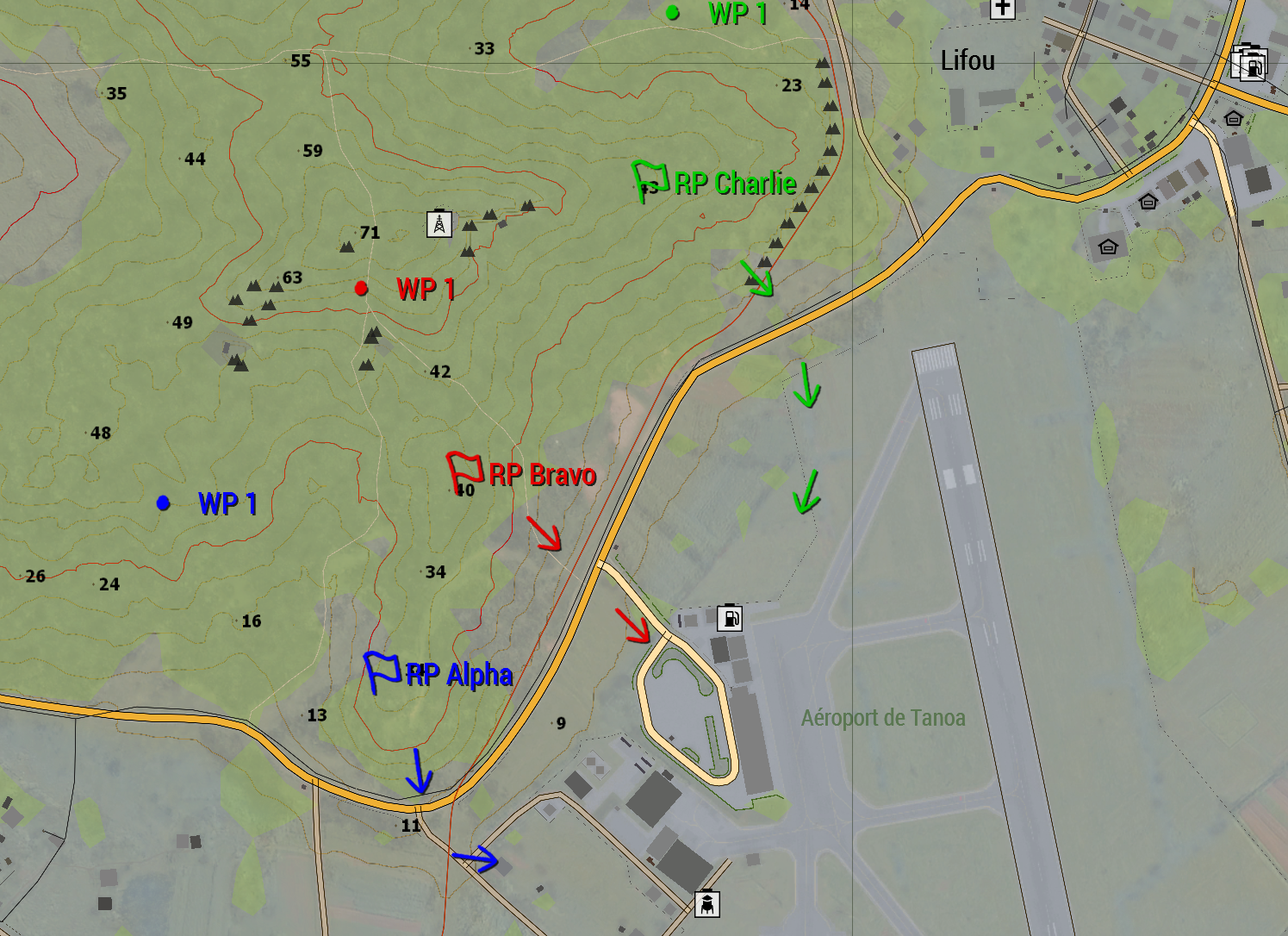
When putting down markers to coordinate the activities of different infantry elements within the platoon, you should ensure to use colours that are easily distinguishable from each other to avoid confusion about who should be going where. The colours used should be as follows:
 |
||
|---|---|---|
| Platoon Command | ||
| Unknown | ||
 |
 |
 |
| Reaper-1-1 | Reaper-1-2 | Reaper-1-3 |
| Blue | Red | Yellow |
Any markers that are ‘platoon-wide’, either relevant or available to the whole platoon should be marked as follows:
 |
|---|
| Shared Markers |
| Green |
Section Level
Squad levels markers are used to coordinate the activities of a particular section or fireteam. These markers relate to a single element, and as such, should be coloured accordingly.
Waypoints

|
A waypoint is used to indicate the overall route of travel to get to a location or objective. Waypoints should use the dot icon in the colour of the section to which is applies, and should be numbered according to the order in which they are to be taken. For example, WP 1, WP 2, WP 3, etc. Waypoints might be used to navigate forces around known hazards like minefields, areas of enemy contact, or to avoid crossing paths with other friendly forces in the area of operations. |
|
| Marker Name: Dot Colour: Section Colours | ||
Rallypoint

|
A Rally Point refers to a location in which the element will reach and then hold until a pre-determined condition is met. For example, rally points might be used to line up several elements within a platoon in order to attack an objective. In this case, the pre-determined condition is that all of the elements are in-place before the section moves off. |
|
| Marker Name: Flag Colour: Section Colours | ||
Platoon Level
Platoon Level markers apply to all elements within the platoon. For the sake of simplicity, the markers are generally themed. Under no circumstances should the names overlap, for example, having LZ Alpha, HP Alpha and IP Alpha is a really bad idea, in a rush it’s easy for any number of mistakes to occur with these markers not being easily distinguisable.
Landing Zone

|
A Landing Zone, commonly referred to as an 'LZ', is a location that has been judged to be suitable for drop-off of supplies and troops via helicopter. The following video by Dsylexci gives good advise on selecting appropriate LZs. |

|
| Marker Name: Pickup Colour: Civilian Naming Themes: Animals Naming Examples: Dog, cat, sheep, rabbit, duck, horse, chicken, llama, goat, lion, tiger, elephant, wolf, zebra, bear, fox | ||
Hold Point

|
A Hold Point is used by a Forward Air Controller or JTAC to designate an area where aircraft should position themselves and loiter. The purpose of this could be to keep transport assets away from danger, but close to the potential contact area in the event that they are required for a hasty exfill or to keep them within radio range. |
|
| Marker Name: Circle Colour: Civilian Naming Themes: Fish Naming Examples: Goldfish, swordfish, carp, salmon, shark, trout | ||
Ingress Point

|
An Ingress Point is a waypoint specially reserved for aircraft. A JTAC or Forward Air Controller can specify a direction of travel from the IP to the target area (could be an LZ, or a CAS target). |
|
| Marker Name: Start Colour: Civilian Naming Themes: Metals Naming Examples: Gold, silver, iron, copper, nickel, mercury, titanium | ||
Emergency Rendezvous Point

|
An Emergency Rendezvous Point (or ERV) is an emergency meetup location to be used in the event that an element takes heavy losses, or looses contact with other teams in the AO. If broken teams converge on an ERV, it aids any rescue attempt as command will know where to find them. |
|
| Marker Name: End Colour: Green Naming Themes: Fruit/Veg Naming Examples: Apple, pear, melon, peach, lime, mango, avocado, lettuce, pumpkin, potato, celery, garlic | ||
Supply Point

|
A supply point indicates the location of an ammunition dump or medical resupply. They'll often be located close to (or practically on) an LZ. |
|
| Marker Name: Square Colour: Green Naming Themes: Shapes Naming Examples: Square, triangle, rectangle, pentagon, rhombus, oval | ||
Triage Point

|
In the event that a mass casualty event occurs, or if an element, or multiple elements, are going to be stationary for a prolonged period of time, a triage point will be established with one or more medics put in charge of the casualities in this area. This will default to the platoon medic unless unavailable. The benefit of a triage point is that all casualties can be gathered in one place (usually sheltered) to be treated at the same time. As triage points are temporary, and relative to the local forces, they are just named 'Triage Point'. |

|
| Marker Name: Join Colour: Opfor | ||
Sectorisation
Sectorisation is the act of splitting up an objective or location into smaller areas. It allows you to assign areas of responsibility to different elements, all the while ensuring the friendly elements don’t unknowingly cross paths - resulting in a friendly fire incident.