Combined Arms
Overview
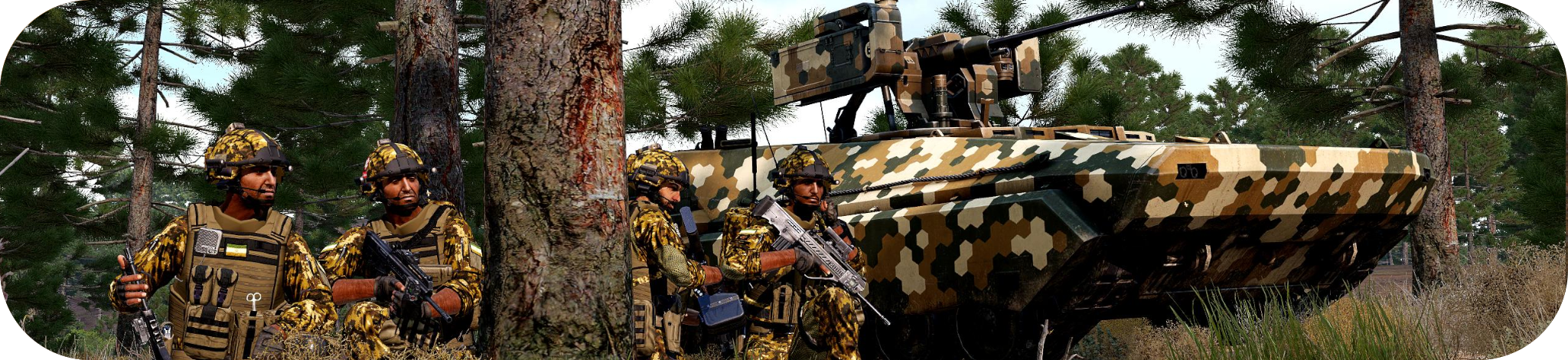
In this section of the guide, we’ll explore some of the additional fire support assets that can be used to augment the fighting capabilities of the platoon. Specifically, we’ll look at what roles they can play in theatre, and their various methods of employment and delivery.
Indirect Fires
Indirect Fires (also known as IDF) are a method of fire support whereby the asset does not rely on direct line of sight in order to deliver ordinance onto the target area. Within the context of ArmA, this relates to Field Artillery and Mortars.
Types
These IDF systems can be deployed in a number of different ways - with each of these having their own strengths and limitations. The type of deployment should be the subject of careful consideration, as it may have transport and logistical considerations outside the scope of just the munitions that it can deliver.
Man-Portable Mortars
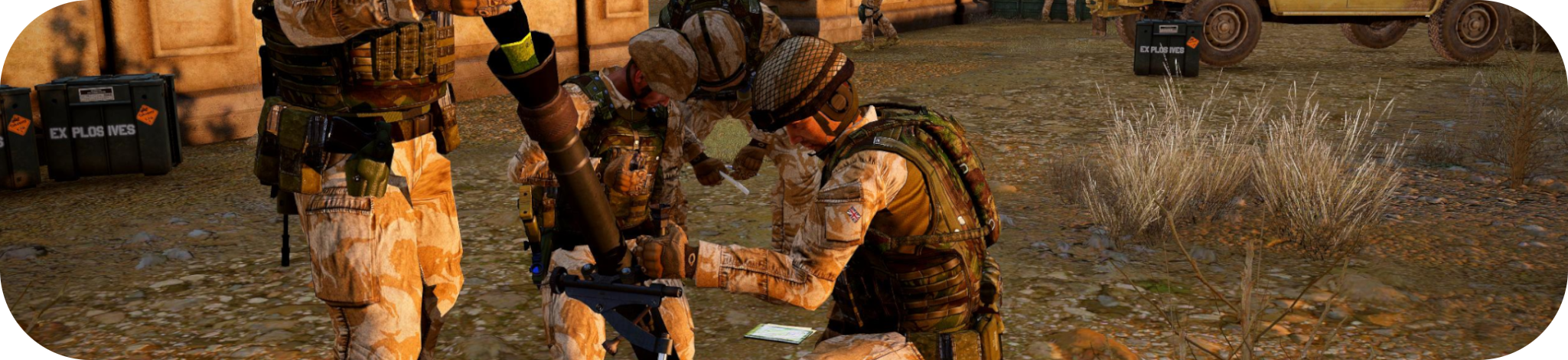
A man-portable system refers to a smaller system that be carried, setup, and employed by a small team moving on foot. This is typically utilising either a 60mm or 82mm mortar system, with one person responsible for carrying the mortar baseplate, and another for carrying the tube itself.
Strengths
- Small Signature - One advantage of a man-portable mortar system is that it generally has a smaller signature. More specifically, a small group of infantry are harder to spot and are generally more adept at staying hidden from advanced optical systems like thermal imaging. This ability to stay hidden allows unit to setup with minimal disruption, and allows them to sustain longer periods of uninterrupted fire before opposition forces are able to figure out their location.
- Highly Agile - Another benefit of this system is it’s capability of getting to those hard-to-reach places. Wherever the infantry can go, the man-portable mortar can go. This is particularly advantageous when working with difficult or rugged terrain - that may pose issues to vehicles or aircraft.
Limitations
- Limited self-sustainment - A disadvantage of this deployment type is it’s heavier requirement on a regular logistical support. As mortar shells are usually carried in backpacks by members of the team, the unit can only sustain a small number of low-intensity fire missions before a resupply of mortar ammunition will be required.
- Slower Movement - Running counter to this units greater agility, is that of their limited movement speed. As this unit is usually moving on foot, they lack the capability of rapidly relocating from one position to another.
Howitzers
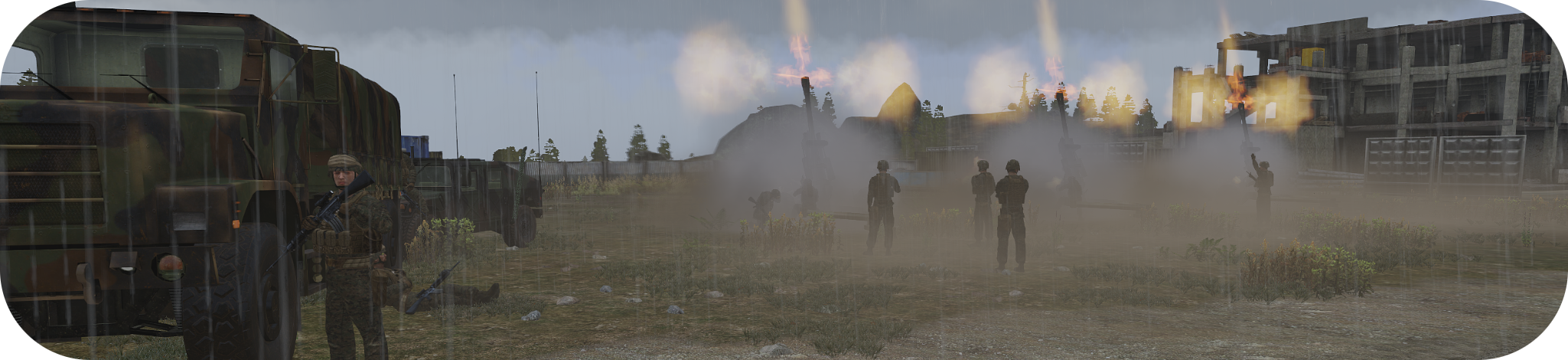
Like a man-portable mortar system, these artillery pieces are independent weapon systems, but usually field a slightly larger calibre such as the 105mm shells. Unlike the man-portable systems, these systems require external vehicles or aircraft in order to facilitate their movement. These systems can often either be towed by lighter motorised vehicles, or airlifted by aircraft with a big enough lift capacity in order to handle the additional weight of the artillery piece.
Strengths
- Larger Calibre - Since these turrets are often being moved by a vehicle of some kind, they are able to field a larger calibre than their man-portable counterpart.
- Longer Range - In conjunction with the larger calibre comes an increase in effective range.
Limitations
- Vehicle Dependence - Quite a significant limitation of this platform is it’s heavy reliance on vehicle transport for relocation. No matter if it’s by helicopter airlift, or being towed by a motorised vehicle, if you sustain any loss of these assets - you are rendered incapable of relocating these systems until fresh vehicles can be acquired.
- Counter Battery Vulnerability - Linked to the above point about an inherent vehicle dependence, this system - especially if airlifted - can find itself incredibly vulnerable to opposition counter battery Fires. For example, after firing a volley, you may need to wait on the availability of air assets in order to relocate the platform to a fresh firing point. This risk factor can be largely mitigated if A) the opposition possesses no such capability or B) the transport assets are organic to the battery, allowing them to relocate without dependence on a third party.
Self-Propelled
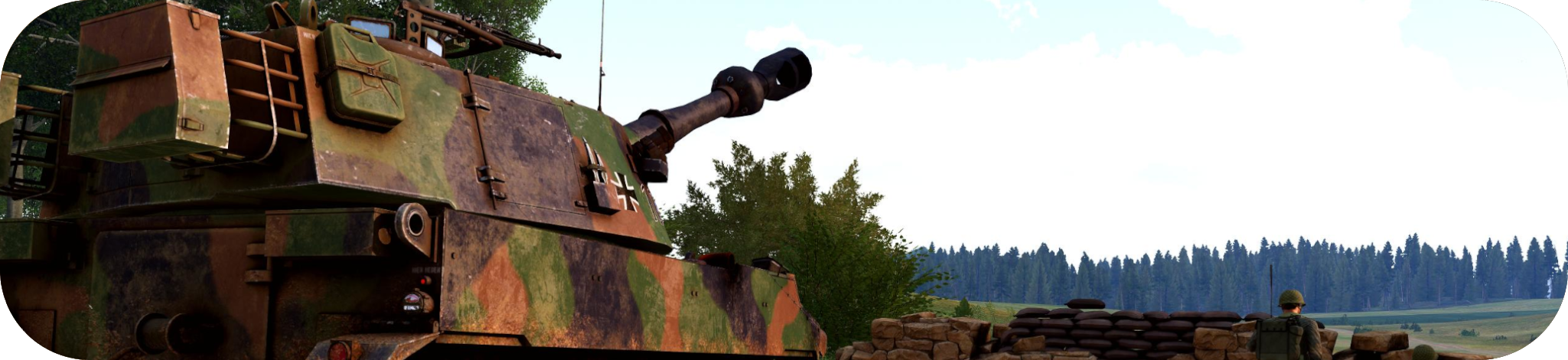
This type of artillery features an integrated method of propulsion, and can also be referred to as a ‘Self-Propelled Gun’ or ‘SPG’ for short. These systems often have a high degree of mobility and self-sustainment, as they are less reliant on external transportation.
It’s not unusual for these systems to be mounted on a tracked chassis, benefiting from a number of the advantages commonly attributed to armoured vehicles - such as protection from small arms and shrapnel, providing additional security to the crew in the event that they come under fire, or are subject to counter battery Fires from enemy assets.
Such systems can take the form of single howitzer turrets, or multiple launch rocket systems.
Strengths
- High Mobility - Vehicles within this battery are able to move under their own steam, not requiring any external vehicles in order to reach suitable firing positions.
- High degree of self-sustainment - As ammunition is contained within the vehicle, there is no requirement to carry around additional ammunition crates, decreasing the overall logistical burden of operating.
- Crew Protection - In many cases, armoured variations of these guns can provide additional protection to crew in the event that they come under direct fire.
- Long Range - As these systems are mounted on dedicated chassis, they are often capable of fielding some of the largest calibres of artillery available - such as 155mm shells, or 230mm rockets. These high-calibre weapon systems come with certain range advantages.
Limitations
- Large Signature - In addition to the signature produced by the weapon platform itself, these systems are (usually larger) vehicles operating an engine of some kind. These factors contribute to a larger signature, both when viewed with the naked eye, and when viewed via advanced optical systems such as thermal sights. This large signature may render these systems more vulnerable to attack from things like opposition CAS assets.
- Slower Movement - The presence of these heavier-calibre weapon systems often results in additional strain on engine performance - As such, these vehicles can be expected to be slower than most unburdened vehicles, and therefore potentially less capable of withdrawing from an area quickly in the event of trouble.
Roles
In this section, we’ll explore some of the roles that these assets can fill within an operation. It’s not uncommon to have a team fulfil a multiple of these roles, as it makes for a more engaging experience and reduces the amount of downtime experienced.
Direct Fire Missions
This type of tasking involves taking direction from forward-deployed elements, fulfilling requests to strike particular enemy positions. This can often include striking targets like machine gun nests, entrenched infantry positions, bunkers and other buildings. This type of fire mission will usually be called in by the leader of a particular element, with an indication of a location and a specific number of rounds requested.
Counter Battery
As well as fulfilling direct tasking, batteries can be involved in the detection and suppression of opposing indirect Fires assets. Methods of detection can include utilising a counter battery radar system, or using positional data directly reported from elements in the field. In extreme circumstances, batteries might chose to strike positions that potentially contain opposing batteries, but this is rare as the risk of collateral damage is high.
Area Suppression
In addition to precision strikes, batteries can opt to introduce a spread into the positioning of shells, denying a wider area to opposition forces. In the context of defending against an enemy counter-offensive, this can involve suppressing either a suspected or current line of advance, helping to fix opposition forces in place, or ‘thin the herd’ of approaching forces.
Non-Lethal Munitions
A helpful (but often forgotten) application of indirect Fires is the use of non-lethal munitions. Such munitions include things like illumination or smoke rounds. Illumination can be used either to provide a light source to troops in the field, or to light up enemy positions to make them easier to spot. Alternatively, smoke rounds can be used to mask the position of troops in contact, disrupting the opposition forces capacity to make visual contact with friendly forces - therefore reducing the effectiveness and accuracy of their fire.
Air Defence
While not a requirement of an indirect Fires battery, there is the additional option of having this team operate some kind of air defence platform. Collocating these capabilities together can be a logistically and tactically sound move, as both assets should be positioned away from the frontline in order to operate most effectively. Secondarily, having these assets together, reduces logistical burden by allowing supplies for both platforms to be delivered to the same location, rather than separate ones.

Tactics
In this section we’ll outline some of the tactics that can be employed by indirect Fires units.
Shoot & Scoot
This tactic involves the rapid relocation of a battery after a fire mission in order to avoid enemy counter battery Fires. This is usually best implemented with self propelled systems as they can fire and immediately move - without the requirement to attach these systems to other vehicles.
Recon by Fire
Reconnaissance by fire refers to a technique whereby a battery will deliberately give away their position away to opposition batteries, in the hope of invoking a response that can then be used to find and fix opposition batteries.
Employment
In this section of the guide we will talk about how direct fire missions can be called.
It’s highly likely - unless an excess of personnel are present - that any friendly batteries will be present on the command network with the other platoon elements. As a result of this, requests for fire missions must be kept as brief as possible - not containing an excess of information which may have the unintended side effect of clogging up the net, and preventing more urgent traffic from getting through.
Generally speaking a fire mission should be requested by first placing a yellow exclamation mark on the map, and giving it a unique name like ‘fire 1’. The call can then be placed to the asset along with the requested number of shells and their type.
Markers should be deleted after use to avoid any confusion and prevent map clutter.
Example:
Reaper-1-1: Hammer this is Reaper-1-1, requesting 5 times HE rounds on marker 'Fire 1' to the North of our position
Hammer: Acknowledged 1-1
...
Hammer: Fire mission complete
Additional Considerations
Damage Assessment
As a consequence of being far removed from the front line, indirect Fires assets are often unable to judge the effectiveness of any strikes conducted. There are a couple of techniques that can be employed in order to close that feedback loop and allow the battery to adjust it’s Fires based on the outcome of a strike.
Direct Feedback
The first of these is the most straightforward and probably the most obvious, which is to have the element that called in the strike to provide direct feedback to the battery. There are a couple of limitations to this approach, however. The first of these limitations is that this back and forth can generate additional radio chatter, to somewhat mitigate this issue, direct feedback should only be provided when there is a need to adjust the rounds - otherwise it should be assumed that no news is good news. A secondary limitation of this approach is that it temporarily fixes a callsign in place while they wait for the rounds to impact, as they need to maintain visual contact with the position in order to provide feedback.
Forward Observer
An alternative to having strikes directly coordinated by close-combat sections is to have Fires be controlled by a forward-deployed scouting element. This has advantages, as it allows for a full and complete feedback cycle without tying up the platoon’s combat capable units. Additionally, such an element has the advantage of being smaller in nature and therefore able to move with a much greater degree of subtlety than the average rifle section.
The employment of this type of Fires coordination is often limited by it’s additional personnel requirements. Even to stand up a small scout team, it requires the presence of a few additional bodies who are happy to spend their time away from the fighting, sat of top of a hill talking on the radio - it doesn’t always make the most compelling gameplay. An additional limitation comes from the (often) small size of these observation elements. As standard, you could reasonably expect these scout teams to consist of between 2 - 4 players. This size has a limited capacity for sustainment, especially when in contact, and can easily find themselves facing off against overwhelming firepower if compromised.
Drones
The use of unmanned vehicles presents itself as a nice alternative to the presence of a forward observer in theatre. This solution allows the battery to maintain a direct eye on the situation on the front lines, without using up many (if any) additional troops. Drone terminals can be shared across multiple team members - avoiding the need for the drone operator to be a dedicated role. This also allows the team to maintain a tighter feedback loop, as targeting information can be shared locally within the team.
The limitation of this approach is that you can sometimes be limited by the capabilities of the drones you are using. Ground vehicles may be limited by drivable terrain, rotary wing man-portable drones (like the quadcopter) may have a limited flight time, and larger drone systems like the predator require dedicated airfields in order to operate effectively.
Civilian Presence
Probably the most significant factor when it comes to the deployment of indirect Fires is the presence (or lack thereof) of civilians within the combat zones. Our RoE usually restricts our capacity to deploy these assets on any location that may cause collateral civilian causalities. When such areas make up the majority of the Area of Operations (AO), alternative, more direct, fire support elements should be employed instead.